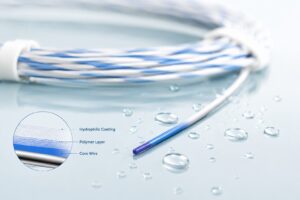
 Hydrophilic coating technology continues to shape the next generation of medical guide wires used in minimally invasive procedures across urology, gastroenterology, vascular intervention, and endoscopy. Manufacturers are increasingly incorporating advanced hydrophilic surface treatments to improve device performance in complex clinical environments.
Hydrophilic coatings are activated when exposed to saline or body fluids, creating an ultra-low-friction surface that allows the guide wire to move more smoothly through anatomical pathways. This reduces insertion resistance, improves trackability, and helps physicians navigate tortuous anatomy with greater precision while minimizing tissue trauma.
Modern guide wires combine these coatings with high-performance core materials such as nitinol and stainless steel to achieve an optimal balance between flexibility, torque control, pushability, and durability. As a result, clinicians can maintain precise control during procedures such as ERCP, ureteral access, biliary interventions, and vascular catheterization.
Another area of innovation is coating durability. Manufacturers are investing in stronger polymer bonding technologies that help maintain lubricity throughout longer procedures while reducing the risk of coating degradation. Surface engineering has therefore become a key differentiator in guide wire development alongside core design and tip configuration.
As minimally invasive procedures continue to expand worldwide, hydrophilic-coated guide wires are increasingly regarded as the preferred solution for demanding clinical applications. Ongoing advances in coating technology are expected to further improve procedural efficiency, physician control, and patient safety across a wide range of interventional specialties.
Source: https://hydromer.com/medical-device-design-hydrophilic-coatings-role/